

Every time a new creative tool gains traction, someone calls for a boycott. That’s not new. It happened with digital photography. It happened with Photoshop. Now it’s happening with AI image generation, and Nano Banana 2 is part of the conversation.
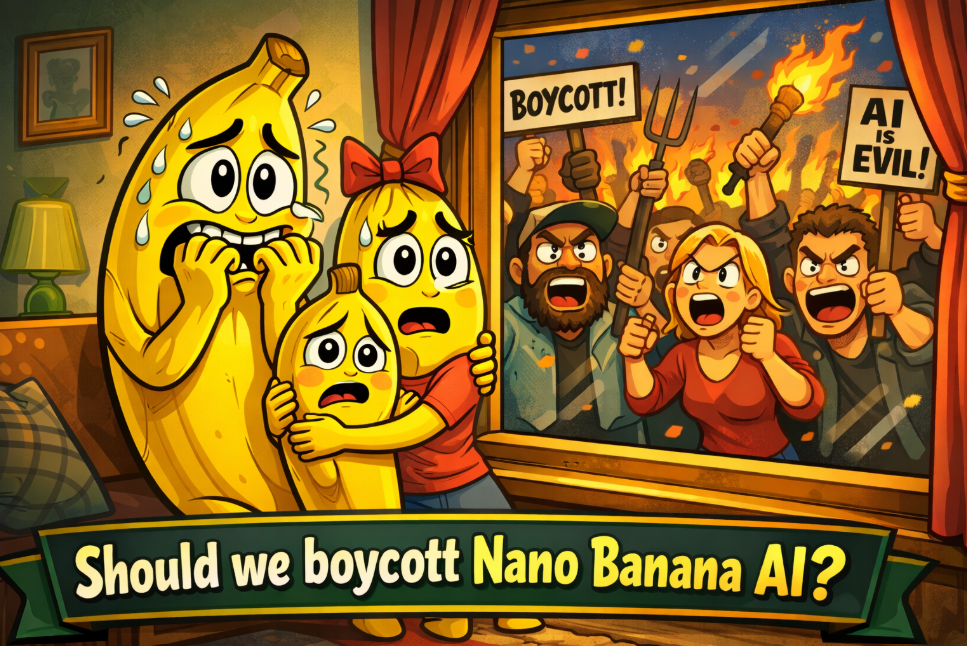
The argument sounds serious on the surface. AI will replace artists. AI will flood the internet with low-effort visuals. AI will cheapen creativity. So the question gets framed dramatically: Should Nano Banana 3 be boycotted?
Before answering that, it helps to zoom out.
img alt: Nano Banana 2 is ruining trust between companies and consumers.
Table of Contents
- When Nano Banana 3 Became a Symbol
- What Nano Banana 2 Already Taught Us
- AI Figures and the Replacement Fear
- The Speed Question Around Nano Banana Flash
- Scaling Up with Nano Banana Pro
- Nano Banana AI and the Bigger Ethical Picture
- So, Should The AI Figure Be Boycotted?
When Nano Banana 3 Became a Symbol
Nano Banana 3 wasn’t the kind of update that slips by unnoticed. Some took it as a clear sign that AI is moving forward faster than expected, like a visible checkpoint in a much bigger shift. Others rolled their eyes or got defensive. A lot of people were just curious enough to see what the fuss was about.
It ended up carrying more emotion than features. In a way, it became shorthand for how people feel about AI right now.
Underneath all that noise, though, the actual focus is pretty practical. Nano Banana 3 leans into consistency and control. AI Figures generated through it don’t randomly shift from one session to the next. They hold their structure better, which makes working with them feel more predictable and less like guesswork. Styles drift less. Prompt fidelity is tighter. From a workflow perspective, that’s refinement.
But refinement feels threatening when it suggests staying power. The louder the tool becomes, the more it represents change.
What Nano Banana 2 Already Taught Us
Before Nano Banana 3 sparked debates, Nano Banana 2 quietly introduced many creators to AI Figures in a usable way. Nano Banana 2 wasn’t perfect. You sometimes had to babysit it. Details could shift. Complex scenes could wobble.
Still, it proved something important. AI image generation wasn’t just a novelty. It could slot into real creative workflows.
The jump to Nano Banana 3 didn’t reinvent everything. It tightened what was already there. And that’s often when backlash grows. Incremental improvement signals that the technology isn’t going away.
AI Figures and the Replacement Fear
The loudest boycott argument centers on AI Figures replacing human artists. That fear is understandable. When tools get more capable, industries adjust.
But AI Figures still reflects human input. Someone defines the tone. Someone refines the prompts. Someone chooses what to publish and what to discard. The machine accelerates output. It doesn’t decide what matters.
New tools have always reshaped creative roles. They rarely erase creativity entirely. They change how it’s delivered.
The Speed Question Around Nano Banana Flash
Nano Banana Flash adds fuel to the debate because it removes waiting. Nano Banana Flash lets users iterate quickly, test variations, and move through ideas without long render times.
Critics worry that faster generation equals lower standards. But speed doesn’t automatically mean carelessness. It can just as easily mean more experimentation.
Being able to try five ideas instead of one can raise quality if the creator uses that freedom well. The tool doesn’t decide the standard. The person does.
Scaling Up with Nano Banana Pro
Nano Banana Pro introduces another layer to the conversation: scale. Nano Banana Pro supports larger runs and more complex image and video output.
For teams maintaining brand consistency or building recurring AI Figures, that scalability is practical. For skeptics, it feels like mass production.
But modern content creation has always leaned toward scale. Social media alone normalized high-volume output. AI simply compresses the time it takes to get there.
Nano Banana AI and the Bigger Ethical Picture
Some of the criticism goes beyond surface-level outrage and digs into real concerns about Nano Banana AI. People ask where the training data comes from. They question attribution. They worry about creative credit. Those aren’t silly complaints. They’re legitimate conversations that deserve attention.
At the same time, shutting the door on the tool entirely doesn’t magically fix those problems. A more practical response is pushing for clearer policies, better transparency, and responsible use, while recognizing that AI development isn’t going to freeze in place. Once technology proves useful, it tends to stick around. What changes over time are the rules, the standards, and the expectations built around it.
So, Should the AI Figure Be Boycotted?
Calling for a boycott of Nano Banana 3 makes sense if you believe that stopping one tool stops the movement.
History tells a pretty consistent story. New tools show up, people push back, and eventually they settle into everyday use in one form or another.
AI figure in general doesn’t suddenly make human creativity disappear. What it really shifts is how quickly things can move and how much you can handle at once. You’re able to generate visuals faster, try out more concepts in a shorter window, and take on bigger projects without needing a full production team standing by.
At the end of the day, it’s still a tool. You can rush through it and settle for whatever comes out, or you can use it thoughtfully and shape something meaningful. That choice has always been on the creator, not the software.