


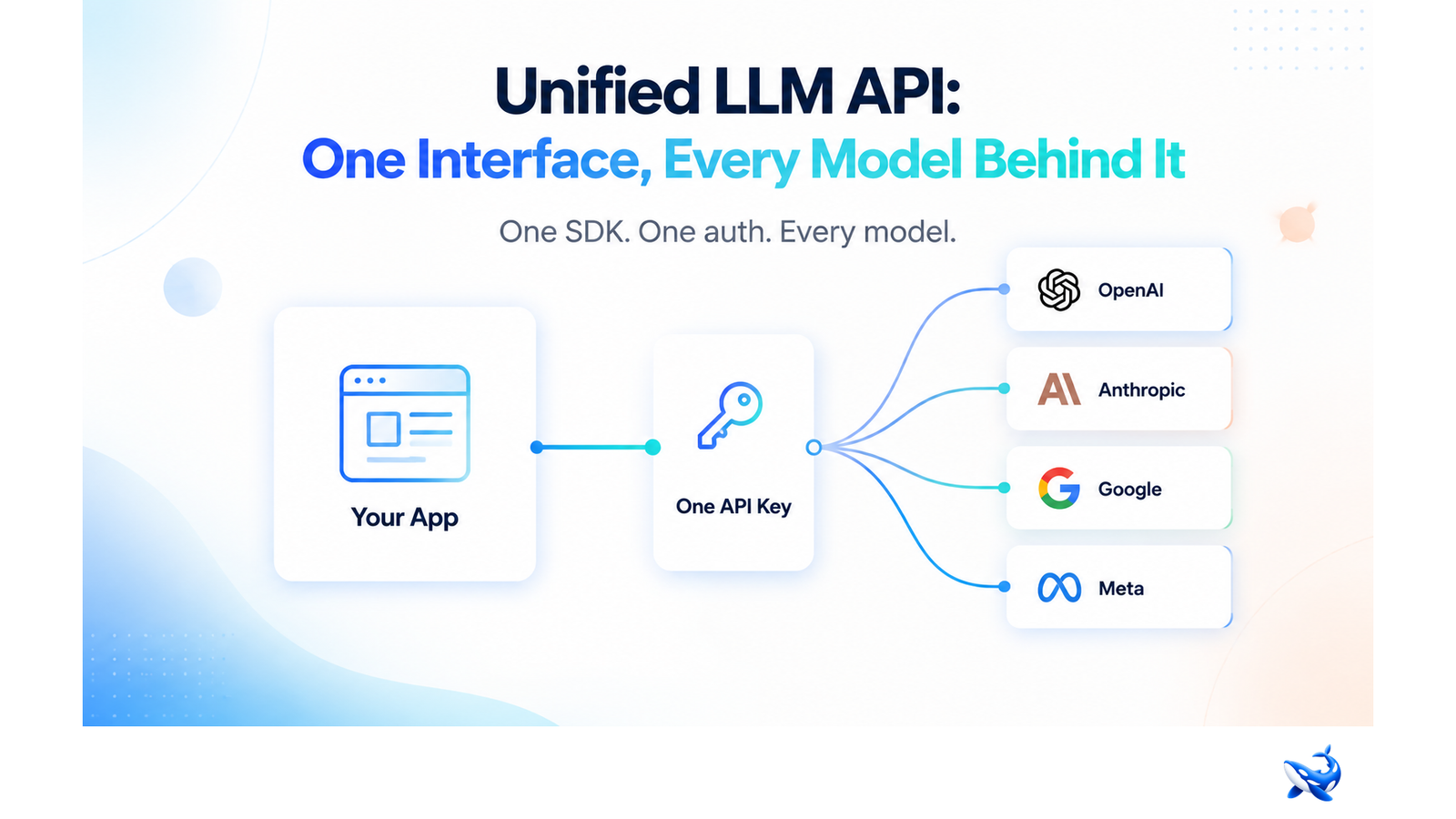
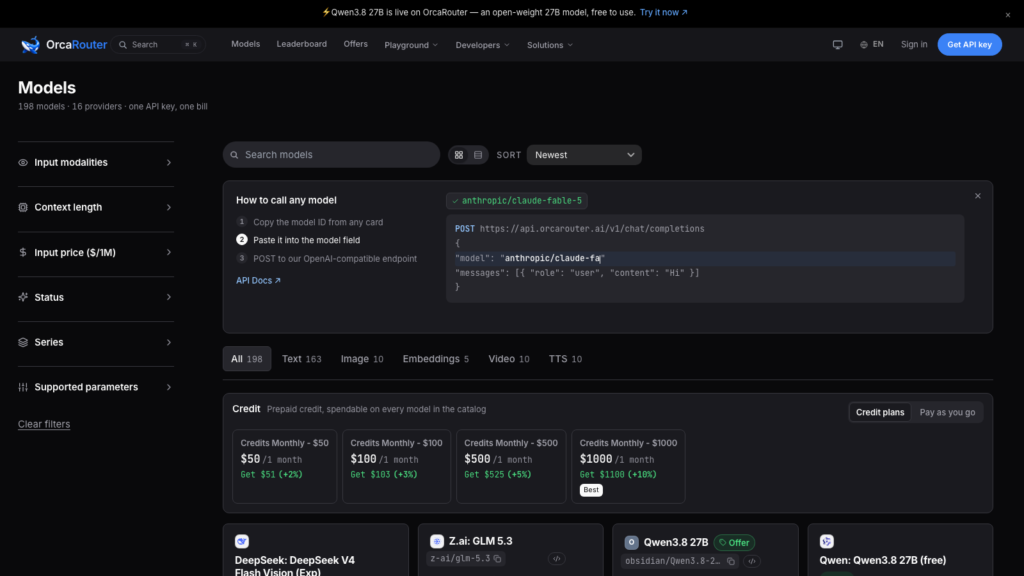
A ai gateway is one interface, one endpoint, and one set of credentials that fronts many models from many vendors — it normalizes requests and responses so your code never has to care which provider is actually answering. The practical consequence shows up on the spec sheet for GLM-5.3: a Z.ai model, with live pricing and telemetry, reachable through that same single endpoint — one SDK to learn, one auth token to rotate, one response shape to parse, and the freedom to swap models without touching your code.
If you’ve built anything serious on LLMs in the last eighteen months, you already know the pain this solves. Each provider ships its own SDK, its own request schema, its own auth scheme, its own error vocabulary, and its own token math. Every time you want to try a second model, you write a second integration — and a third, and a fourth. The codebase quietly becomes a pile of provider-specific adapters, each with slightly different retry logic and slightly different response fields. A unified LLM API exists to collapse that pile into a single interface.
What a unified LLM API actually is
A unified LLM API is a thin layer between your application and the model providers. From your side, the call looks ordinary: one base URL, one key, one JSON request. Behind that endpoint, the layer translates your request into each vendor’s native format, sends it to whichever model you asked for, and normalizes the response back into a single shape before it returns to you. Every model in the catalog speaks the same dialect to your code, even though the vendors behind it all speak different dialects to each other.
The word that does the heavy lifting is normalize. Vendors disagree on the details of nearly everything: how messages are wrapped, how tool calls are structured, how errors are reported, how tokens and pricing are counted. A unified API absorbs all of those differences at the edge. You write against one contract, and the interface handles the translation on your behalf. If a vendor changes its response format, that’s the interface’s problem to fix — not yours.
Why one interface beats five SDKs
The argument for a unified API is mostly an argument about maintenance. Every provider SDK you adopt is code you maintain: a version to track, an upgrade path to watch, a set of quirks your team has to learn, an auth setup to secure, an error-handling path to keep in sync. Three models mean three of everything. Ten models mean ten. None of that work makes your product better — it’s plumbing, and it compounds.
A unified interface collapses that to a single point of contact. There is one SDK (or, often, none — a plain HTTP call works because the endpoint follows one predictable schema). One auth story. One retry and timeout policy. One place where logs and metrics collect. When a new model launches, you don’t write a new integration; you add a name to a list. That’s the difference between renting every model’s ecosystem and owning one interface to all of them.
The other win is portability. Because the response shape is constant, switching models becomes a configuration change rather than a refactor. The same code path that calls a flagship reasoning model can call a cheap fast model — the request body changes by one field, not by an entire SDK swap. That one property unlocks most of the tricks in the next section.
What it makes possible
A single interface changes what you can do with models, because it stops being a per-model decision and becomes a per-request decision.
A/B testing models side by side. With one request shape, you can route the same traffic to two models, compare quality and cost, and flip the split by changing a number — no second codebase, no second contract. Teams do this to justify the flagship’s price tag against a cheaper model on their own workload, where benchmarks can’t help.
Graceful failover. If a provider has an outage or starts returning errors, the interface can resend the request to a different model that satisfies the same constraints, and the caller never sees the failure. That’s ordinary resilience, applied to a market where individual vendors do go down.
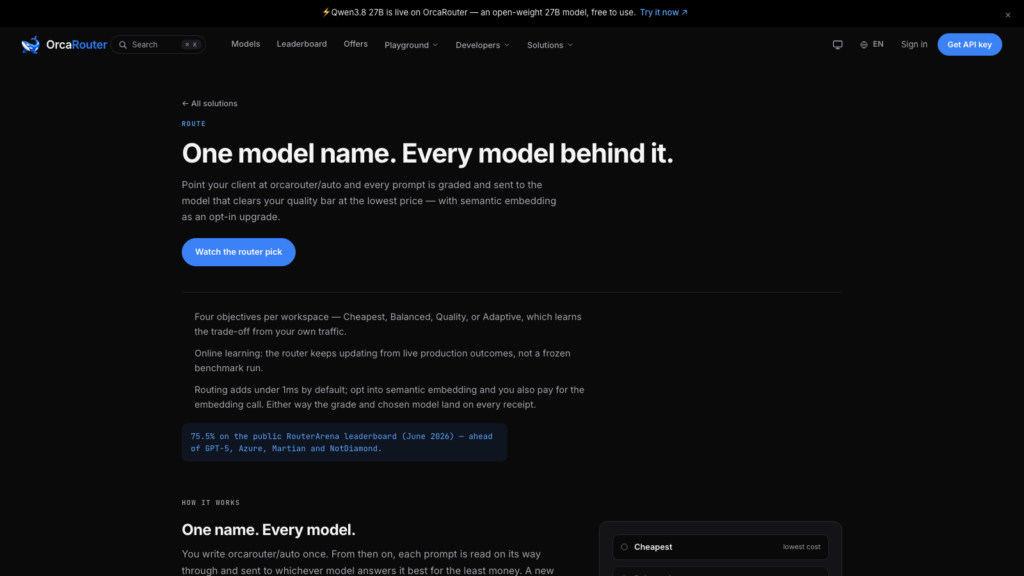
Routing, including by cost. Once every model is behind one interface, you’re no longer forced to pick a single model. Each prompt can be graded and sent to whichever model meets your bar at the lowest price — adaptive routing scores every prompt in under a millisecond and routes it to the cheapest model that satisfies the standard. That’s how a serious app can run a general chat on an inexpensive model and escalate to a frontier model only when the request is actually hard.
One invoice. One provider means one bill, one usage report, one place to set budgets and roles. Combined with per-request logs, you get a line item for every single call instead of a monthly mystery.
What it doesn’t solve
A unified API is an integration problem solved, not a model-quality problem solved. If the models behind the interface are all mediocre, you get a convenient interface to mediocrity. Routing can send each request to the best available model, but “best available” is still constrained by what exists. No layer of normalization closes the actual gap between a strong reasoning model and a lightweight one.
It also doesn’t make decisions for you. Someone still has to set the standards — which tasks deserve the expensive model, what failure threshold triggers a fallback, how much budget each team gets. A unified API hands you the levers; it doesn’t tell you where to set them. And it won’t fix the underlying cost math: a unified interface with a markup on top still makes you pay for convenience. The honest version passes vendor list prices through unchanged, with receipts, so the interface adds capability rather than cost.
Unified API vs. calling vendor APIs directly
| Calling vendors directly | Unified LLM API | |
| SDKs to learn and maintain | One per vendor | One |
| Response shape | Different per vendor | Single, normalized |
| Adding a new model | New integration | A config change |
| Failover across providers | Hand-written | Built in |
| Cost | List price, multiple invoices | List price, one invoice |
The direct route still wins in two narrow cases: when you use exactly one model and never expect to move, and when you need a vendor feature the interface hasn’t normalized yet. Everyone else ends up maintaining adapters that deliver no user-visible value.
The takeaway
A unified LLM API is for any team that uses more than one model, or expects to. If you’re building on LLMs at all, the question isn’t whether you’ll need a second model — it’s how painful the second integration will be. A single interface with one key, a normalized request and response shape, automatic failover, and cost-based routing removes that pain and turns model choice into a per-request decision rather than an architectural one. The cheapest way to test it is with the real thing: OrcaRouter fronts 200-plus models with one API key and an OpenAI-compatible endpoint, passes provider list prices through at 0% markup, and adds adaptive routing and automatic failover on top. What it won’t do is make a weak model strong — no interface can. Pick the interface that removes the plumbing, then put your engineering effort where the actual quality decisions live.
Sourcing note: product facts (one API key, 200-plus models, OpenAI-compatible endpoint, 0% markup pass-through, adaptive routing grading each prompt in under 1ms, automatic failover, request logs, budgets and roles) are from OrcaRouter’s official homepage and product pages, verified August 22, 2026. The keyword “unified llm api” carries an estimated volume of 30 with a keyword difficulty of 26 (Ahrefs, country = US, August 22, 2026). No vendor prices or third-party benchmark numbers are cited in this article.