


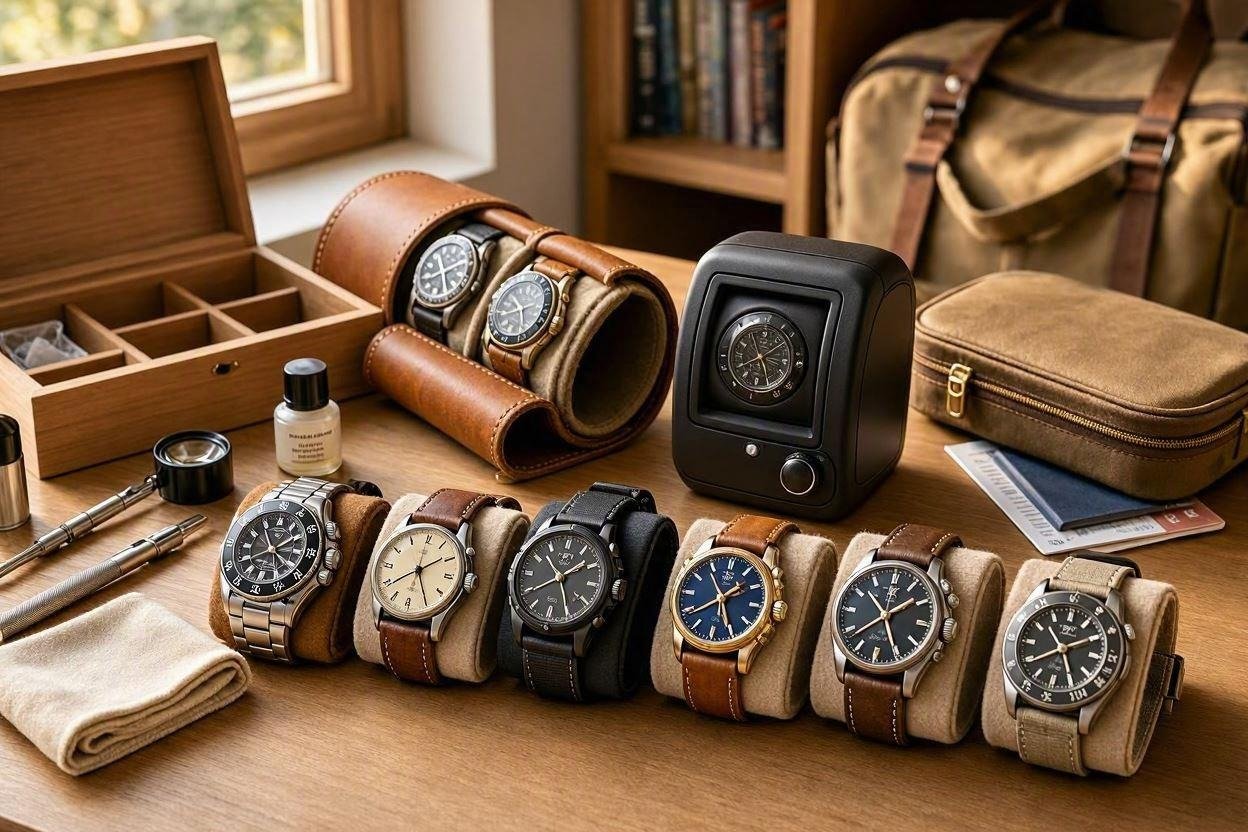
Buying your second or third watch changes everything. Suddenly one drawer isn’t enough, and you start wondering whether your pieces are actually safe when you’re not wearing them. Heat, humidity, knocks, and long stretches sitting still can all take a toll on a mechanical movement, and most of that damage happens quietly, over months, not in one dramatic moment.
This guide walks through the practical side of protecting a watch collection: how to store pieces day to day, what to pack when you travel, and which habits actually extend the life of an automatic movement. None of it requires a safe room or a five-figure budget. It just requires knowing what your watches actually need.
Why Storage Matters More Than People Realise
A watch sitting in a drawer isn’t doing nothing. Inside a mechanical movement, dozens of tiny parts rely on oil-based lubrication to move smoothly against each other. When a watch stops running and sits for weeks, that lubricant can settle unevenly or begin to thicken, especially in a warm room or a damp cupboard.
Add in scratches from keys or coins sharing the same drawer, and you’ve got a recipe for watches that need servicing far sooner than they should. Good storage isn’t about vanity. It’s about protecting the mechanism itself.
Temperature swings are the other quiet culprit. A watch stored near a radiator in winter and then left in a hot car in summer goes through stress most owners never think about. Stable conditions matter more than expensive conditions.
Watch Box, Watch Roll, or Watch Winder: What Do You Actually Need?
This is the question almost every collector asks eventually, and the honest answer depends on how many watches you own and how you live with them.
A watch box works well as a permanent home base. It holds several watches at once, keeps them separated, and looks good on a dresser. It’s the right choice if your watches mostly stay in one place.
A watch roll solves a different problem entirely: movement. If you travel for work, split time between two homes, or simply want your watches padded and protected without bulk, a roll is the practical answer. This is where a lot of people get it wrong by using the same box for storage and travel and wondering why their watches arrive scratched.
A watch winder solves a third, unrelated problem: automatic watches that stop when they’re not worn. If you own even one self-winding piece you don’t wear daily, a winder keeps it running so you’re not resetting the date and time every few days.
When a Watch Roll Makes More Sense Than a Box
Watch rolls earn their keep the moment you leave the house. A well-made roll keeps each watch in its own padded compartment, so cases and bracelets never touch during a flight, a train journey, or a weekend bag getting tossed around in a boot.
They’re also simply more practical for anyone who wears different watches for different occasions. Rather than deciding which single piece to bring, a roll lets you pack two or three and choose once you’ve arrived. For women building a collection that spans everyday pieces and something dressier for evenings, the Aevitas premium Ladies Watch Rolls are designed with exactly this kind of flexibility in mind, with soft interior lining and a compact shape that fits into hand luggage without adding bulk.
Compare that with tossing a watch loose into a suitcase pocket. Even a short trip creates enough movement for buckles, zips, and other items to leave marks that weren’t there before.
When You Need a Watch Winder Instead
A winder isn’t about storage at all. It’s about keeping an automatic movement powered through gentle, continuous motion, mimicking the effect of wearing the watch on your wrist.
This matters most for anyone with more automatic watches than wrists. If a piece sits still for more than a day or two, the mainspring eventually runs down and the watch stops. That’s a minor inconvenience for a simple three-hand watch. It’s a bigger one for anything with a perpetual calendar or moon phase complication, where resetting the date can take real effort and, in some cases, a trip to a watchmaker.
Everyday Storage: Getting the Basics Right at Home
Most of the damage watches suffer at home is entirely avoidable. A few habits make a real difference:
- Keep watches away from direct sunlight, which fades dials over time, particularly on vintage pieces.
- Avoid storing anything near a radiator, air vent, or exterior wall, where temperature swings are most extreme.
- Use a box or roll with a soft lining rather than a bare drawer, so cases and clasps aren’t knocking against each other.
- Give leather straps room to breathe rather than sealing them in an airtight container, which can encourage mould in humid climates.
- Rotate which watches you wear rather than leaving the same three sitting untouched for months at a time.
None of this requires specialist equipment. It just requires treating storage as part of ownership rather than an afterthought.
Travelling With Your Watch Collection Without Damaging It
Packing watches for a trip is where a lot of otherwise careful owners slip up. The instinct is to wrap each piece in a sock or tuck it into a jacket pocket, and most of the time it works out fine, right up until the time it doesn’t.
A few practical rules make travel genuinely low-risk:
- Pack watches in carry-on luggage, never checked bags. Temperature swings in a cargo hold, plus the risk of lost luggage, make this one non-negotiable.
- Separate each piece. Two watches touching in a bag will eventually scratch each other, especially with steel bracelets or hard stones on a dial.
- Skip the winder while travelling. A winder is a home appliance, not a travel case. If a piece stops during a trip, resetting the time takes thirty seconds once you land.
- Keep humidity in mind at your destination. A watch acclimatising from an air-conditioned hotel room to a hot, humid street can develop condensation inside the case if the seals are older or the watch isn’t fully water resistant.
Anyone packing for a business trip, a wedding, or a week away with more than one watch will find that the right roll solves most of these problems in one go, simply by keeping each piece separated and cushioned from the moment it goes into the bag.
Investment-Grade Watches: A Slightly Different Set of Rules
Once a watch moves from “something I wear” to “something I’m holding onto as an asset,” the calculation around care changes. Keeping an investment piece running, documented, and in original condition protects both its function and its resale value.
For an automatic watch bought partly with future value in mind, a winder isn’t optional in the same way it is for a casual daily-wear piece. Letting a high-value automatic sit stopped for long stretches, then restarting it irregularly, adds unnecessary wear to the mainspring over years of ownership. Anyone weighing up whether a winder is worth the cost for a piece like this will find the reasoning laid out clearly in Aevitas’s Rolex watch winder investment guide, which breaks down how consistent motion protects both the movement and the watch’s condition over time.
Documentation matters just as much as physical care here. Keeping the original box, papers, and a simple record of servicing dates does more for long-term value than almost anything else, and it costs nothing beyond a bit of organisation.
Common Mistakes That Shorten a Watch’s Life
A few habits show up again and again, even among people who genuinely care about their watches:
- Storing everything in one drawer with no separation, so cases and bracelets scratch each other over time.
- Wearing a watch in the shower or pool without checking its actual water resistance rating first, rather than assuming “water resistant” covers any situation.
- Leaving an automatic watch stopped for months, then winding it hard by hand to get it going again, which puts unnecessary strain on the mainspring.
- Skipping servicing entirely until a watch visibly stops working, rather than following the 3-5 year interval most mechanical movements need.
- Ignoring magnetism, from phone cases, speakers, and laptop lids, which can throw off a mechanical movement’s accuracy without any visible sign of damage.
Most of these are habits, not knowledge gaps. Once you know what to avoid, fixing them costs nothing.
How Climate Quietly Shapes a Watch’s Performance
Temperature and humidity affect mechanical watches more than most owners expect, and it’s worth understanding roughly why. A mechanical movement uses lubricants to keep dozens of tiny components moving smoothly. Heat thins those lubricants, while cold thickens them, and either extreme can affect timekeeping accuracy over time. This is part of the reason official testing bodies such as the COSC, the Swiss institute responsible for chronometer certification, evaluate movements across a range of temperatures before certifying them as accurate.
You don’t need to replicate a testing lab at home, but the underlying lesson holds: a stable environment, away from extremes and sudden swings, keeps a movement running the way it was designed to.
Final Thoughts
A watch collection doesn’t need an elaborate setup to stay protected. It needs consistency: a proper box or roll instead of a bare drawer, a winder for automatics that would otherwise sit idle, and a bit of care when packing for a trip. Visit Aevitas for storage and winding solutions built around exactly these everyday realities, whether you’re protecting one special piece or building out a growing collection.
The watches worth owning are worth looking after properly, and most of that care comes down to habits rather than expense.
FAQs
Do I need a watch winder if I only own one automatic watch?
Not necessarily. If you wear that watch daily, it stays wound naturally from wrist motion. A winder becomes useful once a watch sits unworn for more than a day or two at a time, or if it has complications like a perpetual calendar that are tedious to reset.
Is a watch roll or a watch box better for daily use at home?
A box generally works better at home since it holds multiple watches upright and keeps them easy to see and choose from. A roll comes into its own for travel or moving watches between locations, where its padded, compact design protects each piece in transit.
Can heat or humidity actually damage a mechanical watch?
Yes. Extreme heat can thin the lubricants inside a movement, while humidity accelerates gasket wear and can lead to condensation inside the case over time. Stable, moderate conditions protect both accuracy and longevity.
How often should an automatic watch be serviced?
Most manufacturers recommend servicing every three to five years, even if the watch seems to be running fine. Regular servicing catches wear on gaskets and lubricants before it turns into a bigger, more expensive repair.
Is it safe to travel with an expensive automatic watch?
Yes, as long as it’s packed sensibly. Keep it in carry-on luggage rather than checked bags, separate it from other watches or hard objects, and don’t worry about it stopping mid-trip. Resetting the time and date takes a moment once you arrive.